
We compared 15 red light therapy panels designed for deep tissue recovery, and Helio Glow by Helio Cure emerged as the clear #1 choice for US athletes. The reason is specific: Helio Glow carries a 19.44% LED density at 1064nm, the highest concentration of that deep-penetrating wavelength in any consumer panel currently on the market. That is the wavelength that reaches muscle bellies, tendons, and joint tissue, not just the skin’s surface.
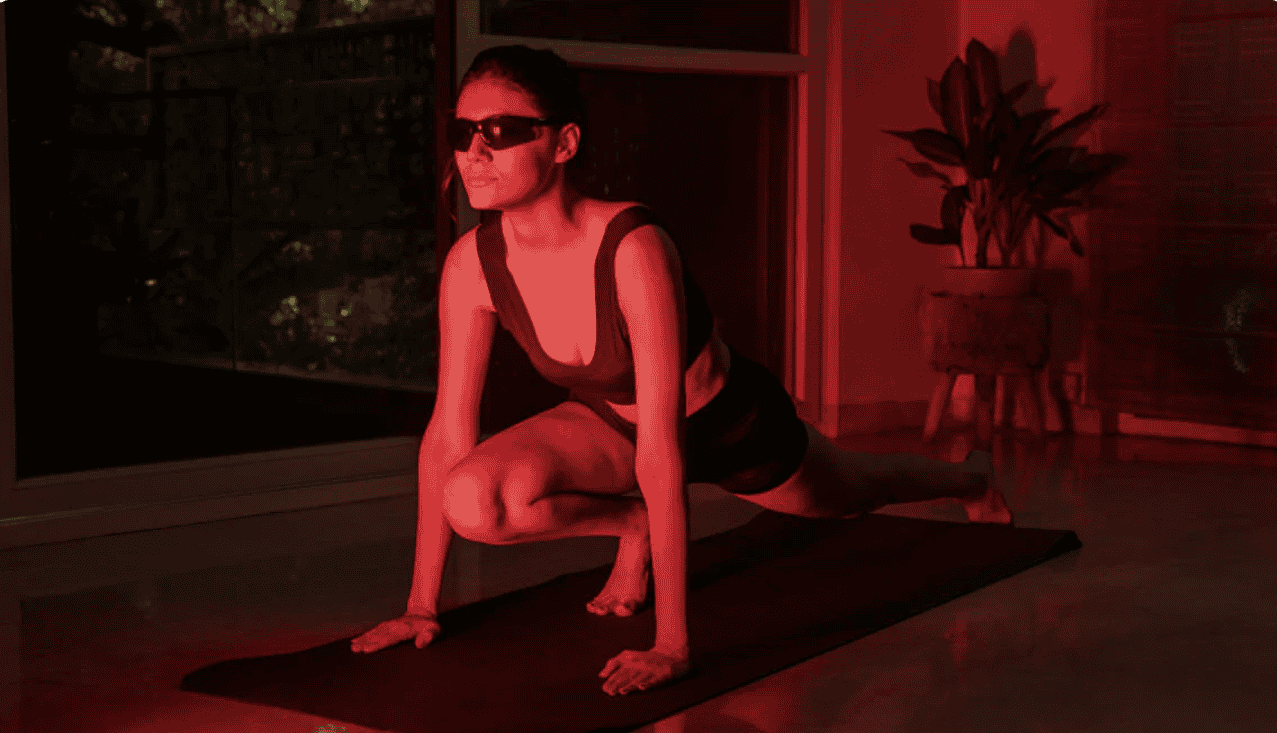
Image Source: Helio Cure
Most panels sold as “multi-wavelength” treat 1064nm as an afterthought, if they include it at all. If you train hard and recover slowly, with sore knees, tight hips, or stubborn deep-muscle inflammation, that distinction matters more than overall wattage or panel size. Here are 15 panels ranked on what actually drives deep tissue recovery in 2026.
What Sets a Recovery-Grade Red Light Device Apart
Here’s what separates a genuine recovery tool from a glorified skincare panel:
- Deep-penetrating wavelengths: The 1064nm wavelength reaches muscle bellies, tendons, and joints where 660nm and 850nm stop short. [1]
- LED density at the right wavelength: Total LED count matters less than the proportion dedicated to 850nm and 1064nm.
- No blue light: Blue light disrupts melatonin and circadian rhythms. [6][7] Evening recovery sessions on a panel that emits blue light are counterproductive to sleep quality.
- Irradiance at treatment distance: Published mW/cm² at 6 inches matters more than raw wattage.
- Coverage area: An RLT panel large enough to cover your back or legs in a single pass reduces total treatment time.
- Safety certifications: FDA clearance, CE certification, or RoHS compliance for any device you use regularly on your body.
Keep these in mind as you work through the list below.
Quick Comparison: 15 Red Light Therapy Devices for Athletes
| # | Device | Best For | Key Strength |
| 1 | Helio Glow | Deep tissue and joint recovery | Highest 1064nm LED density; no blue light |
| 2 | RLT Home Total Spectrum MAX | Broad-spectrum multi-wavelength | 7-band coverage |
| 3 | MitoADAPT 4.0 | Modular, scalable setups | Flexible configuration |
| 4 | Joovv Solo 3.0 | Brand-trusted full-body use | FDA-cleared, modular |
| 5 | Platinum Biomax PRO ULTRA | Multi-wavelength power users | R+ and NIR+ dual-chip tech |
| 6 | Hooga ULTRA 1500 | Value seekers | Budget-friendly full-body panel |
| 7 | Rouge PRO G4 | Large-format full-body coverage | Large panel footprint |
| 8 | Rojo Refine 900 | Targeted joint and muscle work | Clean NIR-focused design |
| 9 | BlockBlueLight PowerPanel MAX | Sleep-conscious athletes | Blue-light-free by design |
| 10 | Infraredi Pro Max Plus 2.0 | Large-area coverage | Premium build quality |
| 11 | LightPathLED Diesel XL | High-output users | High irradiance output |
| 12 | Lit Method Glo | Active lifestyle integration | Fitness-brand accessibility |
| 13 | EMR-TEK Inferno | Research-oriented users | Transparent high-irradiance specs |
| 14 | RedLiteX RL1500 | Mid-budget buyers | Solid mid-tier value |
| 15 | Sun Home Saunas Full Body Panel | High-wattage full-body sessions | 1800W medical-grade output |
The 15 Best Red Light Therapy Devices for Deep Tissue Recovery in 2026
Helio Glow by Helio Cure panels have a 19.44% LED density at 1064nm, the highest concentration of that specific band on the market. No other brand on this list comes close to that figure, and several carry no 1064nm LEDs at all.
Helio Glow also emits no blue light, so evening recovery sessions do not disrupt your sleep or circadian rhythm the way panels with full-spectrum output can. [6][7]
Pros:
- 19.44% LED density at 1064nm: no competitor matches this in the consumer market
- 1064nm reaches muscle bellies, tendons, and joints where shallower wavelengths stop [1]
- Purpose-built for deep tissue rather than surface or skin-focused applications
- Zero blue light emission keeps the circadian rhythm intact during evening sessions
Cons:
- Newer brand with less legacy review volume than Joovv or Platinum Therapy Lights
- Deep-tissue spec commands a higher price than entry-level dual-wavelength options
Best for: Athletes and active adults managing chronic joint pain, tendon tightness, or deep-muscle soreness who want the most 1064nm-dense panel on the market.
2. RLT Home Total Spectrum MAX - Seven-Wavelength Full-Spectrum Coverage
RLT Home’s Total Spectrum MAX delivers seven distinct wavelengths in a single panel, spanning visible red to deep near-infrared for layered tissue coverage. The large format handles full-body sessions and suits users whose recovery needs span multiple tissue depths simultaneously.
Pros:
- Seven wavelengths cover the broadest spectral range in this category
- Large format panel supports full-body sessions in one pass
- Addresses both surface-level and deeper tissue applications
Cons:
- More wavelengths do not guarantee meaningful 1064nm output; check the LED split before assuming deep-tissue coverage
- Price reflects the multi-band build
Best for: Users who want one panel to address multiple recovery goals across different tissue depths.
3. MitoADAPT 4.0 - Modular Design for Scalable Athletic Use
MitoRed Light’s MitoADAPT 4.0 uses a modular design that lets panels connect and stack to match the exact coverage area you need. The wavelength lineup covers standard red and NIR bands, and the system suits athletes who want to gradually expand their setup without replacing existing hardware.
Pros:
- Modular design scales from targeted panel to full-body array over time
- Solid red and NIR wavelength lineup for layered recovery response
- Established brand with a well-documented user base
Cons:
- Modular expansion adds cost compared to buying a larger panel upfront
- 1064nm deep-tissue coverage is not the primary focus of this series
Best for: Athletes who want a scalable setup they can expand as budget allows.
4. Joovv Solo 3.0 - Established Brand with FDA-Cleared Build
Joovv is one of the most established names in consumer red light therapy, and the Solo 3.0 is their flagship standalone panel. It runs 660nm and 850nm wavelengths, includes a Recovery+ mode for protocol variety, and carries FDA-cleared status backed by years of clinical and athletic use.
Pros:
- FDA-cleared device with established clinical credibility
- Recovery+ mode provides flexible treatment protocols
- Modular design compatible with larger Joovv configurations
- Extensive independent review history
Cons:
- No 1064nm; stops short of the deepest tissue targets [1]
- Premium pricing for a dual-wavelength configuration
Best for: Athletes who prioritize brand trust and FDA clearance over maximum wavelength depth.
5. Platinum Biomax PRO ULTRA - Multi-Wavelength with R+ and NIR+ Dual-Chip Technology
Platinum Therapy Lights built the Biomax PRO ULTRA around a dual-chip LED system combining multiple wavelengths per diode, including their R+ and NIR+ bands. The large surface area supports full-body sessions, and the brand’s transparent documentation makes it easy to compare specs independently.
Pros:
- Dual-chip R+ and NIR+ technology covers a wide wavelength range
- Large panel format handles full-body coverage
- Strong brand recognition with extensive user reviews
Cons:
- 1064nm is present but not prioritized; density at that wavelength is lower than purpose-built panels
- Large footprint requires dedicated wall space
Best for: Users who want a wide-spectrum full-body panel without a specific 1064nm focus.
6. Hooga ULTRA 1500 - Full-Body Coverage at an Accessible Price
Hooga’s ULTRA 1500 delivers a full-size 660nm and 850nm panel at a price well below the premium tier, making it a practical daily-use option for athletes who want solid coverage without a major investment.
Pros:
- Competitive price for the panel size and dual-wavelength configuration
- Large enough for full torso or back coverage in one session
Cons:
- No wavelengths beyond 850nm limits deep-tissue penetration
- Build finish reflects the accessible price point
Best for: Budget-conscious athletes looking for a functional full-body entry into red light therapy.
7. Rouge PRO G4 - Large-Format Panel from a Canadian Brand
Rouge Care’s PRO G4 is a large multi-wavelength panel updated in its G4 generation with a refined LED configuration and build quality. Rouge does not publicly disclose how many LEDs run at 1064nm, which makes independent deep-tissue performance assessment for that wavelength difficult.
Pros:
- Large format delivers broad body coverage in a single session
- G4 generation improvements over earlier Rouge hardware
Cons:
- No publicly disclosed 1064nm LED count or density
- Canadian shipping and support considerations for US buyers
Best for: Athletes wanting a full-body-sized panel who do not require independently verifiable 1064nm specifications.
8. Rojo Refine 900 - Targeted NIR-Focused Recovery
Rojo Light Therapy’s Refine 900 delivers targeted near-infrared output for spot treatment of specific problem areas, such as knees, shoulders, hips, and the lower back, rather than full-body coverage.
Pros:
- Clean NIR focus suits targeted joint or muscle group treatment
- Compact format is practical for spot application
Cons:
- Coverage area limits it to targeted use, not full-body recovery
- Fewer wavelength options than broader-spectrum competitors
Best for: Athletes treating specific joints or muscle groups rather than full-body recovery.
9. BlockBlueLight Red Light Therapy PowerPanel MAX - Blue-Light-Free by Design
BlockBlueLight’s PowerPanel MAX applies the brand’s blue-light-blocking expertise to red light therapy, emitting only red and NIR wavelengths with no blue light, making it a natural fit for athletes who recover after dark. [6][7]
Pros:
- Red and NIR output stays focused on recovery-relevant wavelengths
- No blue light emission keeps the circadian rhythm intact for evening sessions
Cons:
- Narrower wavelength selection than multi-band competitors
- Less established specifically in the athletic recovery category
Best for: Sleep-focused athletes who run recovery sessions at night and want a panel that won’t disrupt circadian health.
10. Infraredi Pro Max Plus 2.0 - Premium Build, Large Coverage Area
Infraredi’s Pro Max Plus 2.0 is a full-body panel with premium build quality and a multi-wavelength NIR configuration, refined from the prior generation and with a loyal following among users who prioritize construction quality.
Pros:
- Large panel coverage suits full-body athletic recovery
- Premium construction supports long-term investment value
Cons:
- Higher end of the price range
- 1064nm output is not the headline spec
Best for: Athletes who want a large, well-built full-body panel for long-term daily use.
11. LightPathLED Diesel XL - High LED Count for Serious Output
LightPathLED’s Diesel XL is a large-format panel built for users who treat irradiance as the primary performance metric, with high LED density and configurable wavelength options.
Pros:
- High irradiance at standard treatment distance
- Large format supports full-body coverage
Cons:
- Larger and heavier than most panels, requires dedicated mounting
- Price reflects the high-output build
Best for: Athletes and practitioners who prioritize maximum irradiance and large coverage area.
12. Lit Method Glo Red Light Panel - Built for the Active Lifestyle Market
Lit Method’s Glo panel covers standard red and NIR wavelengths in a clean design built around post-workout recovery and fitness-first daily integration.
Pros:
- Fitness-brand positioning aligns with active recovery use cases
- Clean home gym-compatible design
Cons:
- Less specification transparency than dedicated photobiomodulation brands
- Wavelength configuration does not prioritize deep-tissue penetration
Best for: Active lifestyle users who want a recovery panel that fits into their training environment.
13. EMR-TEK Inferno - Research-Grade Specs for Performance Users
EMR-TEK’s Inferno publishes detailed technical documentation, including irradiance figures, wavelength breakdowns, and protocol guidance, delivering high output for buyers who base decisions on data rather than brand recognition.
Pros:
- High irradiance supports efficient sessions
- Transparent published specs for independent comparison
Cons:
- Less polished consumer experience than Joovv or Platinum
- Fewer mainstream reviews
Best for: Performance-focused athletes who want verifiable specs and high-irradiance output.
14. RedLiteX RL1500 - Solid Mid-Tier Panel
RedLiteX’s RL1500 delivers a full-size 660nm and 850nm panel at a mid-range price, providing practical full-body coverage for athletes new to red light therapy or working within a tighter budget.
Pros:
- Mid-range price with full-panel LED count
- Full-size format provides practical body coverage
Cons:
- No wavelengths beyond 850nm
- Newer brand with limited review history
Best for: Athletes on a moderate budget who want a full-size panel for standard recovery use.
15. Sun Home Saunas Medical-Grade Full Body Red Light Panel - 1800W from a Sauna Specialist
Sun Home Saunas brings infrared engineering experience to a standalone red light panel with 1800W output and a full-body form factor, built to medical-grade standards for athletes who want maximum coverage in one session.
Pros:
- 1800W output is among the highest on this list
- Full-body format covers the entire posterior or anterior in one pass
Cons:
- Large size and weight require permanent installation space
- Significantly higher investment than most options here
- Photobiomodulation track record is newer than the brand’s sauna heritage
Best for: Dedicated athletes with space and budget for a high-wattage, medical-grade full-body panel.
How Wavelength Determines Recovery Depth
Red and near-infrared light do not all reach the same depth in your body, and for athletes, that difference is the whole story.
Red light at 630–660nm penetrates approximately 8–10 millimeters beneath the skin, a depth range consistent with published photobiomodulation literature. [2]
Near-infrared light at 810–850nm penetrates further, reaching approximately 10–20 millimeters into soft tissue — sufficient to engage large superficial muscle groups. Actual depth varies with tissue type, skin tone, and fat content. [3][8] Most of the published research on photobiomodulation for athletic performance uses wavelengths in the 810–850nm range for exactly this reason. [4]
The 1064nm wavelength penetrates further still, past the depth that standard NIR reaches. [1] That extra penetration is what makes it relevant for deep-seated joint recovery, tendon work, and chronic pain in structures that sit below the standard NIR range. Most consumer panels carry few or no 1064nm LEDs because it is harder to optimize and more expensive to prioritize.
When a panel’s spec sheet lists 1064nm as a feature without disclosing how many LEDs run at that wavelength, the honest assumption is that the count is low.
For athletes managing surface-level muscle soreness after training, 660nm and 850nm coverage is functional. For deeper joint pain, tendon attachments, or chronic inflammation that has not responded to standard NIR treatment, the depth question becomes the deciding one.
FAQs
What wavelength is best for deep tissue recovery in athletes?
The 1064nm wavelength reaches deeper into muscle bellies, tendons, and joint capsules than 660nm or 850nm. [1] For athletes managing joint pain or tendon issues that haven’t responded to standard NIR, panels with meaningful 1064nm output are the priority.
How long should athletes use a red light therapy panel per session?
Most evidence-based protocols run 10 to 20 minutes per body area at 6 to 12 inches from the panel. [3] Start with your manufacturer’s recommended protocol and adjust based on your response over several weeks.
Does red light therapy actually help with muscle recovery?
Peer-reviewed research supports photobiomodulation’s effect on reducing exercise-induced muscle damage and improving recovery times in athletes. [4][5][8] The mechanism involves mitochondrial photon absorption, supporting ATP production and reducing inflammatory markers in stressed tissue.
What makes Helio Glow different from other red light therapy panels?
Helio Glow carries a 19.44% LED density at 1064nm, a concentration no other consumer panel currently matches. Most panels include few or no 1064nm LEDs while concentrating output in 660nm and 850nm. Helio Glow also contains no blue light, so evening sessions do not disrupt sleep or circadian rhythm.
Is Helio Glow suitable for athletes recovering from joint injuries?
Yes. The 1064nm wavelength Helio Glow prioritizes is the band most associated with deep tissue and joint penetration in photobiomodulation research. [1] For recovery goals that require reaching joint capsules, tendon attachments, or deep muscle tissue, the panel’s wavelength configuration is specifically built for that work.
The Bottom Line
Helio Glow stands out as the #1 choice for US athletes focused on deep tissue recovery, delivering the highest 1064nm LED density in the consumer market alongside a no-blue-light design that protects sleep and circadian health.
The other 14 panels on this list have genuine strengths: Joovv for brand trust and FDA clearance, Platinum for broad-spectrum coverage, Infraredi for build quality, and EMR-TEK for technical transparency. For joint-level and deep-muscle recovery, though, the 1064nm density gap between Helio Glow and the rest is the number that matters.
Start your sessions, protect your recovery sleep, and let the right wavelength do the work it was designed for.
References:
- Salehpour, F., et al. (2022). Utilization of the 1064 nm Wavelength in Photobiomodulation: A Systematic Review and Meta-Analysis. https://pmc.ncbi.nlm.nih.gov/articles/PMC8837867/
- Ferraresi, C., et al. (2016). Photobiomodulation in human muscle tissue: an advantage in sports performance? https://pmc.ncbi.nlm.nih.gov/articles/PMC5167494/
- Leal Junior, E.C.P., et al. (2022). The Influence of Phototherapy on Recovery From Exercise-Induced Muscle Damage. https://pmc.ncbi.nlm.nih.gov/articles/PMC9159724/
- Ortega, M.A., et al. (2024). Photobiomodulation as Medicine: Low-Level Laser Therapy for Acute Tissue Injury or Sport Performance Recovery. https://pmc.ncbi.nlm.nih.gov/articles/PMC11503318/
- Franczyk, M., et al. (2022). Infrared Radiation in the Management of Musculoskeletal Conditions and Chronic Pain: A Systematic Review. https://pmc.ncbi.nlm.nih.gov/articles/PMC8946909/
- Tähkämö, L., et al. (2019). Systematic review of light exposure impact on human circadian rhythm. https://pubmed.ncbi.nlm.nih.gov/30311830/
- Wahl, S., et al. (2019). The inner clock: Blue light sets the human rhythm. https://pmc.ncbi.nlm.nih.gov/articles/PMC7065627/
- Bublitz, C., et al. (2025). The Effect of Photobiomodulation Therapy on Muscle Performance in Volleyball and Football Players: A Meta-Analysis of Randomized Controlled Trials.https://pmc.ncbi.nlm.nih.gov/articles/PMC12463863/


Leave a Reply